Character and Citizenship Education (CCE)
Explore how CCE at FPPS nurtures character, social-emotional skills, learner agency and active citizenship through meaningful learning experiences.
Vision
CCE is at the heart of education at FPPS, shaping students into responsible individuals with a strong moral compass.
We strive to nurture lifelong learners who are not only of good character but also resilient, socially aware, and curious about the world around them.
With a spirit of curiosity and a heart of gold, our students will be ready to adapt and contribute meaningfully to society in a rapidly changing world.
Approach
School Values:
Care, Curiosity, and Empathy, fostering a culture of kindness, lifelong learning, and understanding.
Social-Emotional Competencies:
Developing Social awareness, self-awareness, self-management, relationship management, and responsible decision-making.
Emerging 21st Century Competencies (21CC):
Critical, Adaptive and Inventive Thinking
Communication, Collaboration and Information Skills
Civic, Global and Cross-Cultural Literacy
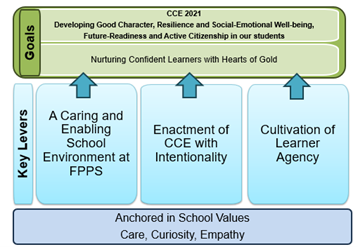
FPPS Character and Citizenship Education (CCE) Framework
Objective
To realise the goals of CCE 2021 by developing:
Good character
Resilience and social-emotional well-being
Future-readiness
Active citizenship in every student
To nurture confident learners with hearts of gold, guided by our school vision, through meaningful and intentional CCE experiences that shape values, build empathy, and empower students to make a positive difference.
CCE 2021 Curriculum Frame and Key Levers @ FPPS
Key Lever 1: A Caring and Enabling School Environment at FPPS
Characterized by caring and responsible leadership, a pervasive growth mindset, emotional and physical safety, and a focus on learning and development of students, teachers and all other members of the school community.
Supportive peer relationships contribute to the building of a caring and supportive peer culture, by students for students.
For the cultivation of dispositions of character and citizenship, and social-emotional well-being.
Students are empowered to become their best selves.
Key Lever 2: Enactment of CCE with Intentionality
Enactment through CCE Lessons during curriculum time, planned student development learning experiences beyond the classroom, teachable moments during other subject lessons and learning opportunities beyond school.
Specific CCE learning outcomes are articulated, and planned activities such as cohort learning journeys are incorporated with the intention of realising the identified learning outcomes.
Key Lever 3: Cultivation of Learner Agency
Creating space for students to be heard and encouraged to play an active role in what and how they learn, provides opportunities for them to develop agency or self-directedness, responsibility and ownership of their learning.
Empowers students to contribute purposefully to their community by providing opportunities for contribution to family, school and community through Values in Action (VIA) projects.
For Education and Career Guidance (ECG), equipping students with the necessary knowledge, skills and values to make informed decisions at each key education stage for successful transition from school to further education or work.
How is CCE taught?
CCE is taught through a variety of learning experiences beyond dedicated CCE lessons. For example, CCE lessons may be reflected as the following in a student's timetable:
CCE (Form Teacher Guidance Period)
CCE (Mother Tongue)
Pendidikan Perwatakan & Kewarganegaraan
品格与公民教育
நற்பண்பு குடியியல் கல்வி
Programme for Active Learning (PAL)
In addition, CCE may be taught through:
CCE Enactment, Platform, Experiences
CCE Enactment | Platforms and Experiences |
|---|---|
Key Student Development Experiences (SDEs) | SDEs are programmes and activities that contribute towards the holistic development of our students in physical, aesthetic, intellectual, moral, and social domains. These include:
|
What do students learn during CCE lessons?
CCE lessons are anchored on three big ideas: Identity, Relationships, and Choices.
From these big ideas, students learn and demonstrate calues and social-emotional competencies through six content areas:
Cyber Wellness
Education and Career Guidance
Family Education
Mental Health
National Education
Sexuality Education
CCE Curriculum Content Areas Table
CCE Curriculum Content Areas | |
|---|---|
|
|